
Project: Juliu$
Date: Jul 2020
My role: Benchmark, user interviews, user flow, ideation and prototype

Project JULIU$

Julius Rock

I was always a big fan of “Julius Rock”,
a character in Everybody hates Chris, played by Terry Crews.
Unplug that clock, boy.
You can’t tell time while you sleep.
That’s two cent$ an hour.
Best of Julius: https://www.youtube.com/watch?v=65ZIsgnykAQ
I was always a big fan of “Julius Rock”,
a character in Everybody hates Chris, played by Terry Crews.

Now that I’m a father and have to pay for bills
that I’ve never thought I would have to pay in my life,
I finally cracked it.
Juliu$ was a genius.
A genius not only because he knew the price of everything,
but because he knew he could save money by saving energy, which is the fuel that moves the entire economy and we just reached a point that is pretty close to impossible to live without it.
We proposed to launch an energy app to one of our clients since they are in the home appliances field. Client was a bit skeptical at the beginning, but gave us a green light.
DEFINING THE PROBLEM
In France we have more than 30 energy supply companies and their prices vary depending on the area and the kind of services the user subscribes for, turning it difficult to measure their spent.
This cost varies because of the cost of supplying energy (supply, production and commercial management)
+ its cost of transmission (transport and distribution networks) + various taxes.
I spoke to 6 users that complained about their bills,
but most of them don’t control their energy waste.
We tested some of the available apps and we found
that some of the platforms were not 100% trustworthy because their rates are not the same, furthermore,
not everyone is a grand connoisseur of watts, volts or bolts,
so they pay for whatever the companies charge at the end
of the month, since they can’t control it before the due date of payment.
Source: https://www.french-property.com/guides/france/utilities/electricity/change_supplier
GOALS
Create a no-brainer app for android and IOS users that calculates their spends in real-time for any appliance without the need of a connected device.
Set a budget for their energy spends per hour, day, week, month and notify users when their determined budget reaches its limit.
Save money by being more conscious about energy and give them tips on which products
can consume less energy.
Get to know their bills before their bills, instead of waiting on the due date for payment to get to know their invoices.

BENCHMARK
I tested 5 of the most prominent apps, collected user’s reviews and found that some of the existing apps are connected devices related to brands, but many users don’t have connected devices at home. Some of the apps are not intuitive asking too much from the users and don’t focus on the user experience.
They definitely don’t take into consideration the fact that
PEOPLE DON'T KNOW ABOUT KILOWATTS OR WATTS.
I’ve also noticed that they only calculate the number of hours and turn these watts into prices. There’s no interaction whatsoever (unless it is an app related to a brand-connected device), there are no tips on which products can be purchased to reduce the energy bills. Most apps calculate the rate into the user’s currency, but they can’t upload any personal info about their bills to be analyzed. Some of them don’t even work properly and some are not accessible enough with a UI that is really difficult to catch up.
STRENGTHS
• Some of the apps include a carbon usage alert.
• Information is provided to users in real-time.
• Users can control energy elements from outside the home.
• View environmental impact.
• Energy reports per hour, day, week and year.
• Technology shows usage in high, mid and low peak hours.
WEAKNESSES
• Some of the apps require personal data.
• Some apps are paid and only work with connected devices.
• No tips about home appliances that consume less energy.
• No tips about better energy companies.
• Don’t cover every home appliance.
• Some info are not up to date.

EMPATHIZE
After anaylising competitors strengths and failures,
doing qualitative user’s interviews with open ended questions, testing these apps with users, we now have
a good basis to create our personas.
USER PROFILES


USER INTERVIEWS

INSIGHTS


PERSONA
This persona helped us in the ideation process to find solutions to people that are not geeks, neither people that don’t know absolutely nothing about technology.
As the majority of users, they are trying to find solutions
to decrease their expanses and increase their life style without harming the environment.
We thought about simple personas that could influence other
users to use the app and move on with their lives.

ANALYZE
Users can actually find their cost per unit in their bills but most people don’t have the interest of taking this info and calculate the annual cost.
Here is the equation:
Consumption (kWh) equals number of hours multiplied by the number of days multiplied by
x power divided by 1000.
3h X 365 days X 100w / 1000 = 109,5 kWh
This is what some apps do for the users or when they call their energy suppliers, but what they don’t have are those numbers per minute to control their expenses.
Later on in the process, we discovered that we should come up with
$ave money.
an app that was absolutely not related to
any connected devices and most importantly,
an easy to use app that required no efforts whatsoever, and could be shared within
the family where everyone was going to be conscious about their energy wastes
on any home appliance and ultimately

IDEATION
The idea here is to have a very simple UI
where anyone could be able to have a pleasant
user experience, and the features inside it,
would do the work making life easier.
APP FEATURES
Users only need to tell the app which energy company they’ve subscribed
with and the brand of the home appliance they want to measure the performance.
Users can also upload their appliances through photos and the AI will recognize
the appliance model. QR code as an option.
Get to know the bills before the bills,
instead of waiting on the due date for
payment to get to know the invoices.
Colorful energy efficiency graphics that show the performances by time of use, day, week, month and year.
Sound recognition in case the user wants to measure how much he is going to spend in the shower for example.
Gamification where the family can share their info in the app and encourage others to spend less and save more.


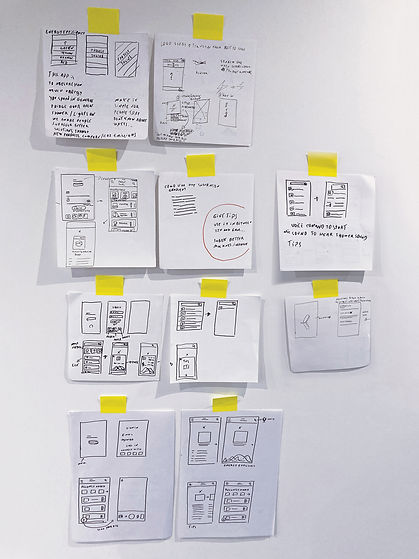
After the ideation process and thinking about all the features, I built my first sketches.
After the ideation process and thinking about all the features, I built my first sketches.
USER FLOW
After the ideation process and thinking about all the features, I built my first sketches.

Decision to be made

Action to be taken


PROTOTYPES
Because they are bold.
You may be asking why a brand would compare their appliances with other products and create and app to give tips on how to save energy and money?
The answer is simple.
This is just another example of a brand that is not afraid of putting themselves into risk to captivate
its users.
But unfortunately client’s budget decreased due to Covid 19 and the project didn’t move on. We didn’t have a chance to test the prototypes or finish the project, but Nothing is lost.
Here are some of the screens i’ve prototyped.


Create account

Log in page

Verifying code

Selecting energy provider
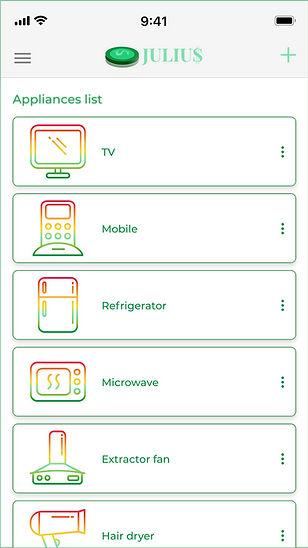
Selecting home appliance

Menu items


Most used home appliances
Home appliance brand
OUTCOME
This project gave me an opportunity to know more about energy and how to be more conscious about energy waste. It most definitely affected me and my family on how we use it nowadays.
Users and stakeholders though the app definitely had something special and could be one of the most downloaded apps covering services that most of the competitor apps don’t cover. Although, it requires some investment and clients were not willing to invest that money at that time, since Covid hit the world and companies were holding it back instead of injecting money.
My managers told me to stop the process and I didn’t have time
or the chance to work on focus groups, user tests, verbatim or quantity data, since this was the initial plan.
Prices per period